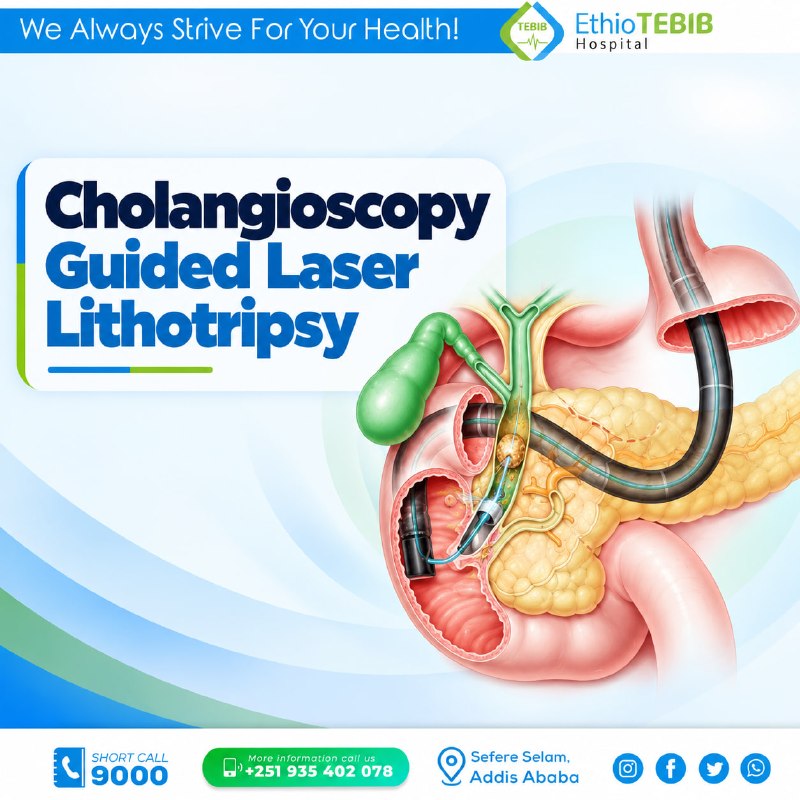
Stones that form or get stuck in the bile duct are usually cleared with ERCP, a scope passed through the mouth to the opening of the duct. A very large stone is a different problem: it cannot be pulled out whole, and the standard tools often cannot break it. For this patient our interventional gastroenterology team used a technique that lets the endoscopist see inside the duct and break the stone with a laser — to our knowledge, the first time it has been done in Ethiopia.
The patient
A woman in her 70s came to Ethio Tebib Hospital with pain under the right ribs and yellowing of the eyes and skin (jaundice). Her gallbladder had been removed more than ten years earlier. She also lived with high blood pressure, an overactive thyroid and obstructive sleep apnoea — all of which make a long open operation riskier and favour a treatment done through a scope.
What the scan showed
An MRCP — an MRI scan tuned to show the bile and pancreatic ducts — found a single giant stone, 2.2 cm across, lodged in the upper part of the common bile duct. A stone that size blocks the flow of bile from the liver, which is what causes the pain and the jaundice, and it is well beyond what a basket or balloon can remove during a routine ERCP.
The treatment
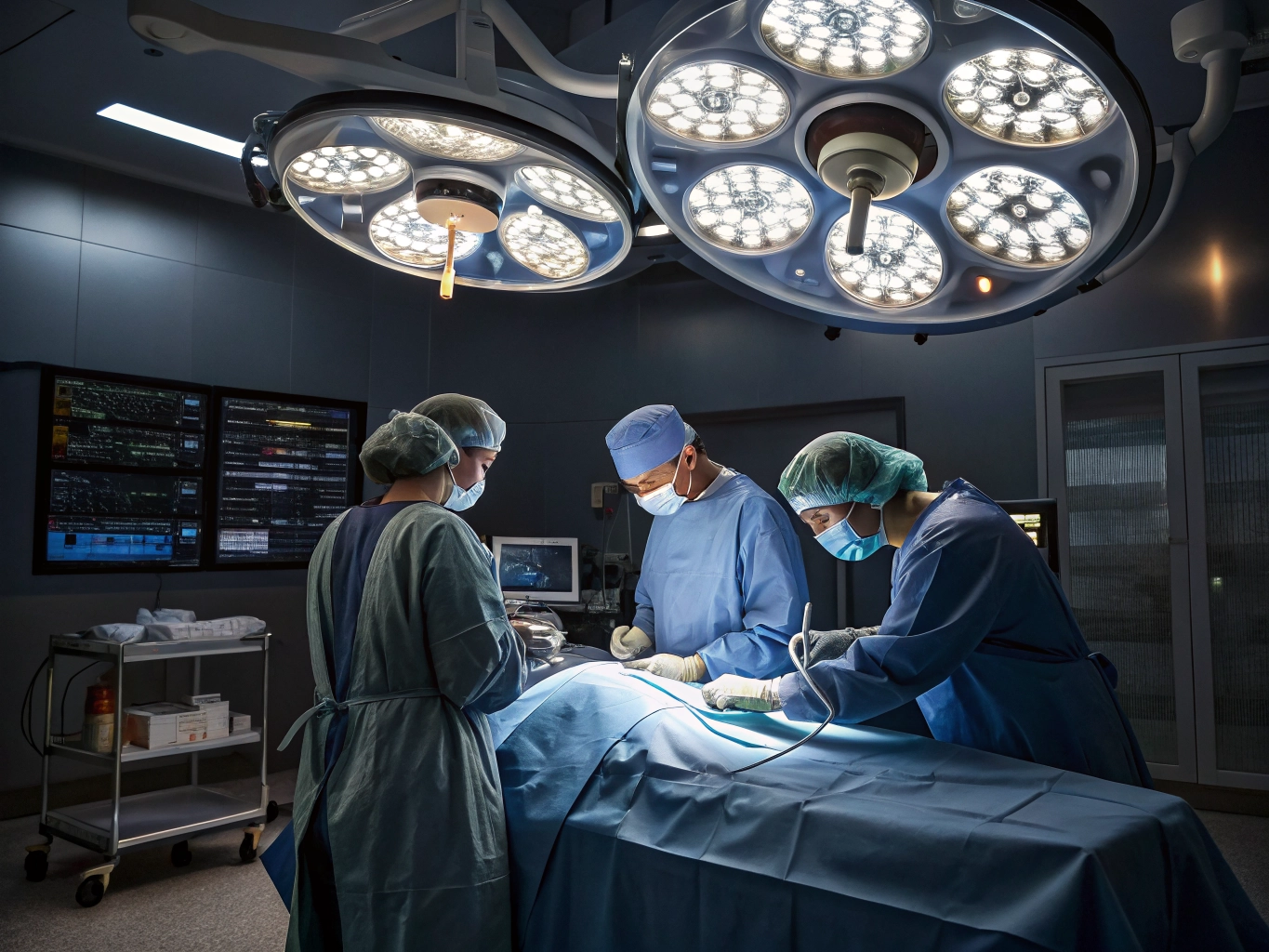
The team performed ERCP with cholangioscopy-guided laser lithotripsy. During the ERCP a very thin second scope (a cholangioscope) was passed up into the bile duct itself, giving a direct camera view of the stone instead of the shadow seen on X-ray. Under that view a laser fibre was aimed at the stone and used to break it into fragments, which were then removed. The whole procedure — fragmenting and clearing the stone — was completed in a single session.
Cholangioscopy changes ERCP from a procedure guided by X-ray shadows into one done under direct vision inside the duct. That makes two things possible that conventional ERCP cannot do: targeted laser or electrohydraulic fragmentation of difficult stones in the bile and pancreatic ducts, and close inspection of suspicious narrowings (strictures) with directed biopsies when cancer has to be ruled out.
Recovery
Her course after the procedure was smooth, with no complications, and the blocked duct was fully cleared.
What you should know
Stones can form in the bile duct years after the gallbladder has been removed. The warning signs are pain under the right ribs, jaundice, pale stools and dark urine; if fever and shaking chills are added, the duct may be infected (cholangitis), which is an emergency — go to hospital the same day.
Most bile-duct stones are removed with a standard ERCP. Stones that are very large, very hard or impacted used to mean either open surgery or travelling abroad. With cholangioscopy and laser lithotripsy now available at Ethio Tebib Hospital, patients with difficult bile-duct and pancreatic-duct stones can be treated here in Addis Ababa.
Related care
- ERCP and endoscopic ultrasound (EUS) — the first EUS service in Ethiopia
- Interventional Gastroenterology Unit
- Internal Medicine
The team behind this case
The procedure was performed by Dr. Abdulsemed Mohammed, internist, gastroenterologist and interventional endoscopist, with the GI endoscopy nursing team and the anaesthesia team at Ethio Tebib Hospital.
Book a consultation
If you have been told you have a bile-duct or pancreatic-duct stone that cannot be removed by routine ERCP, our team can assess whether cholangioscopy is an option. Book an appointment online or call our short code 9000, open 24 hours. Ethio Tebib Hospital is on the road to Kolfe, Sefere Selam, Addis Ababa.
This case was first shared with the medical community on Hakim on 30 October 2026.